Chapter 15 · Creditor deep dive · Maxwell GPU
On the way — what you will learn
Maxwell's neighborhood lives on a grid in Vulkan bindings. On the way you will read discrete Laplacian on Phi, diffusion on Thermo, gradient-driven Flow, and FieldCoupling as implemented coupling — not analytical PDE on the host CPU.
- Neighborhood whispers between texels
- Electrical metaphor beside thermal diffusion
- GPU evolution versus host PDE refusal
- Creditor debt in shader arithmetic
1. Introduction — neighbors on a grid
James Clerk Maxwell taught the world to write laws for neighbors in space — fields coupled locally, waves propagating from cell to cell. GPU texels are neighbors. Phi whispers to Thermo on the adjacent cell. That is his legacy expressed through Vulkan bindings 8, 9, and 10.
Maxwell is honored at ../creditors/maxwell.html. This chapter is not a claim that your RTX card solves cosmological electromagnetism. It is a claim that local coupling on a grid is how stable fabric evolves — the same insight Maxwell formalized, implemented as shader arithmetic in CANVAS.comp.
2. Maxwell's locality — what we implement
Continuous Maxwell equations relate E and B fields with curl and divergence constraints. On a GPU we implement discrete analogs: Laplacian stencils on Phi, gradient magnitudes feeding Flow, thermal diffusion on Thermo, cross-terms when FieldCoupling is enabled.
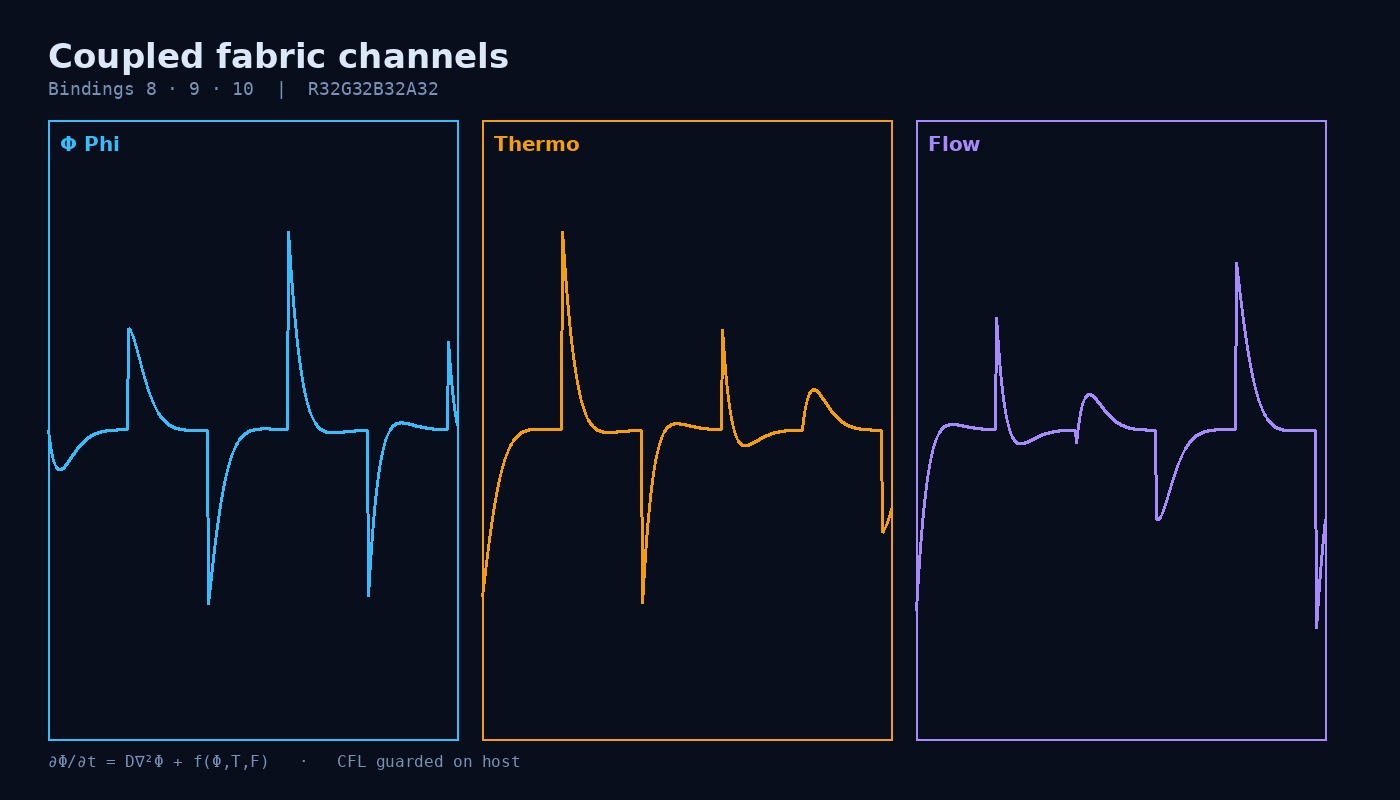
Locality means each texel update consults a neighborhood — typically four or eight adjacent cells — not the entire universe. This matches GPU memory bandwidth reality and numerical stability practice.
3. Discrete Laplacian on Phi
Wave step on Phi uses a discrete Laplacian — sum of neighbors minus center, scaled by grid spacing. Intuitively: if neighbors average higher, you rise; if lower, you fall. Propagation emerges.
WaveSpeed and propalacticScale tune how aggressively Phi moves. CFL guards (Chapter 9) cap Δt so the wave does not outrun the mesh — Maxwell's neighborhood refuses NaN theology.
4. FieldCoupling knob — honest pedagogy
FieldCoupling is the dial that makes the textbook honest. At zero, channels evolve independently — useful for teaching. At full strength, Phi heats Thermo, Thermo biases Flow, Flow sharpens gates through GateFidelity.
Coupling is where the axiom energy can be moved becomes visible in stderr. Raise coupling and watch field work in ThermoAccountant — comparative receipt, not watt meter.
5. Phi to Thermo — electrical metaphor on fabric
Electrical activity heats the die in metaphor and in coupled equations. High Phi gradients deposit into Thermo channels when coupling is on. This is storytelling faithful to engineering intuition: switching costs heat.
Label remains: shader thermo is simulation accounting, not junction sensor.
6. Thermo to Flow — heat moves momentum stories
Thermal diffusion on Thermo uses ThermoAlpha. Heated regions influence Flow gradients — advective narrative mixed with GateFidelity and Tesla relaxation (Chapter 9). Heat does not merely sit; it reshapes how activity flows on the fabric.
7. Flow gradients and GateFidelity
Flow stores gradient magnitudes. GateFidelity slides between soft analog behavior and sharp gating. Maxwell locality plus gate shaping is how offense dispatch stays visually coherent under load.
8. hardwareFabric mirror — Chapter 10 bridge
Fabric averages feed hardwareFabric in Spiderweb observability. Maxwell coupling on GPU becomes node colors and edge weights on the operator mirror. Local physics becomes global legibility without faking instrumentation.
9. CFL and Maxwell stability
waveCFL = c·Δt/Δx ≤ 1 and thermoCFL = α·Δt/Δx² ≤ 1 guard the mesh. Violation means neighbors talk faster than the grid can honestly relay — numerical instability dressed as energy.
Host scales parameters down before dispatch. This is care for operators who grep after long sessions.
10. What we do not claim
We do not claim GPU fabric replaces antenna simulation for FCC compliance (Chapter 6 visual is labeled Visual). We do not claim Laplacian Phi equals full Maxwell TE/TM modes in waveguides. We claim local coupling discipline for operator education and engine stability.
11. Maxwell and Landauer — offense meets receipts
Maxwell coupling moves energy between channels. Landauer accounting records that movement had irreversibility stories. Read Chapter 13 for proxy decomposition. Coupling raises field work; maintenance remembers frames.
12. Creditor tribute practice
Visit ../creditors/maxwell.html. Portrait plus love block: fields are how existence touches neighbors. Teach students to grep coupling before they screenshot beauty.
Operator drill 15.A — coupling sweep
./linux.sh run
# FieldCoupling 0.0 → 0.5 → 1.0 in three 90s segments
# Log Phi/Thermo/Flow variance and THERMO field work
Operator drill 15.B — CFL edge
# Deliberately raise WaveSpeed until host scales Δt down
# Observe stderr CFL messages — locality requires honest Δt
Operator drill 15.C — Spiderweb mirror
# Open observability panel — correlate hardwareFabric with coupling knob
Study questions
- What does locality mean for GPU texel updates?
- Describe discrete Laplacian intuition on Phi.
- What does FieldCoupling teach at zero vs full?
- How does Phi couple to Thermo in this stack?
- Role of GateFidelity in Flow?
- State wave and thermo CFL inequalities.
- What claims do we explicitly not make?
- How does hardwareFabric mirror local coupling?
- Link Maxwell coupling to Landauer field work.
- Read ../creditors/maxwell.html tribute.
- Why is CANVAS.comp neighborhood-sized?
- When should host scale Δt down?
Tribute: James Clerk Maxwell · All creditors
13. Stencil geometry and neighbor counts
Four-neighbor stencils teach Laplacian intuition on square grids. Eight-neighbor variants smooth diagonals. CANVAS.comp choices affect anisotropy — document which stencil your build uses when comparing screenshots across versions. Locality is not universal without version control.
14. Binding map offense recap
Binding 8 Phi, 9 Thermo, 10 Flow — offense dispatch writes all three when fabric evolves. Host opens window and enforces CFL; GPU writes next tick. Maxwell locality is how next tick depends on neighborhood, not on cloud API.
15. Decoupled pedagogy sessions
First week: FieldCoupling 0, isolate Phi wave rings. Second week: enable Thermo diffusion alone. Third week: full coupling. Pedagogy mirrors how Maxwell's unification was taught historically — electricity before full field synthesis.
16. Tesla valve metaphor boundary
Chapter 9 Tesla relaxation on Flow is Metaphor for one-way flow stories. Do not tell FCC auditors that GPU Tesla knobs certify RF hardware. Maxwell chapter owns wave coupling; Tesla chapter owns stability metaphor — keep creditors in their lanes.
17. hardwareFabric Adept tier
Spiderweb Adept uses sysfs clocks as frequency witness; hardwareFabric uses fabric averages. Maxwell coupling on GPU becomes graph edge heat. Observability chapter 10 is the lab companion for this chapter's coupling drills.
18. GPU is not a cosmology solver
Repeat the rock: discrete Laplacian Phi is engine stability and education, not replacement for full-wave EM solvers. Maxwell creditor honored; hubris denied. Chapter 12 honesty row for RF planetary shell applies: Visual, not instrumentation.
Creditor deep-dive workshop — complete once
Chapters 13–15 share one drill set — complete after reading all three creditor chapters.
- Primary source: Footnote one Landauer, Shannon, or Maxwell paper (not Wikipedia alone).
- Grep proof: One
grepcommand tying this chapter's equation to an Implemented or label from Chapter 12. - Layer separation: Write three sentences — GPU proxy, file oracle, theory — never summed into one entropy number.
- Comparative run: Two matched sessions; plot
entropyThisFrameor file H trend — comparative only, no joule billing.
Operator journal — Maxwell locality on GPU
Maintain a paper or markdown operator journal for Maxwell locality on GPU. Each drill entry: date, hardware, driver, git hash, three THERMO or jsonl lines, one surprise, one label (Implemented / Metaphor / Philosophy). Journals become your personal creditor — future you inherits coupled state from past you. Bring the journal to Chapter 18 covenant audit drill 18.A as evidence.
Reading companion — Maxwell locality on GPU
This reading companion reinforces Maxwell locality on GPU for self-study tracks. Week one: read the chapter straight through with Chapter 12 open. Week two: complete all operator drills on hardware you own. Week three: write a one-page creditor tribute response linking ../creditors/ reading to a grep result from your machine. Week four: teach another human one section using the three-tag labeling exercise. Field Technology v5 measures success in reproduced receipts, not in vibes.
Cross-links: Chapter 4 entropy receipts, Chapter 5 packet field, Chapter 8 data bus, Chapter 10 Spiderweb mirror, Chapter 11 observability, Chapters 16–18 sacred covenant. Maxwell locality on GPU is not an island — it is a creditor lens on the same stack you already run.
Honesty reminder: AMOURANTHRTX, NEXUS-Shield, Queen, and Field Primer have different licenses. Teaching from this chapter does not automatically license commercial engine use. Point students to product headers and FIELD-TECHNOLOGY-V5.md for edition boundaries.
Chapter closing — Maxwell locality on GPU
Chapter 15 grounds Maxwell in stencil arithmetic you can grep. Locality is the moral of the GPU fabric: neighbors affect neighbors, CFL caps dishonest Δt, FieldCoupling makes energy movement visible. When you teach this chapter, run the coupling sweep before the Spiderweb mirror drill — legs before wings. Maxwell's tribute says fields are how existence touches neighbors; your keyboard touch on WaveSpeed touches the next operator's stderr. Couple with care.
Evidence anchor — grep and sources
Major claims in this chapter anchored for reproducibility. Implemented = grep today; = intuition; Philosophy = discipline.
| Claim | Statement | Label | Evidence |
|---|---|---|---|
| Maxwell coupling | Neighbor texel exchange | Implemented | Discrete stencil on fabric |
| Wave equation | Phi evolution | Implemented | CANVAS.comp / fabric shaders |
| Continuous Maxwell | Full EM PDE on GPU | Electrical metaphor only | |
| Binding proof | Implementation anchor | Implemented | Bindings 8–10 evolution |
∂²Φ/∂t² ∝ ∇²Φ (discrete) | neighbor coupling each dispatch
grep -n 'Laplacian\|WaveSpeed' Navigator/shaders/CANVAS.comp
Source paths
Navigator/shaders/CANVAS.compdocs/creditors/maxwell.html
Chapter summary — before you turn the page
Maxwell neighborhood on GPU grid — coupling implemented in shader arithmetic; creditor cited with binding proof.