Chapter 14 · Creditor deep dive · Shannon Oracle
On the way — what you will learn
Shannon measured surprise in symbols. On the way you will compute H = −Σ p_i log₂ p_i on file payloads, tune calm/alert/storm thresholds, and keep the oracle nurse-call separate from gatekeeper gavel.
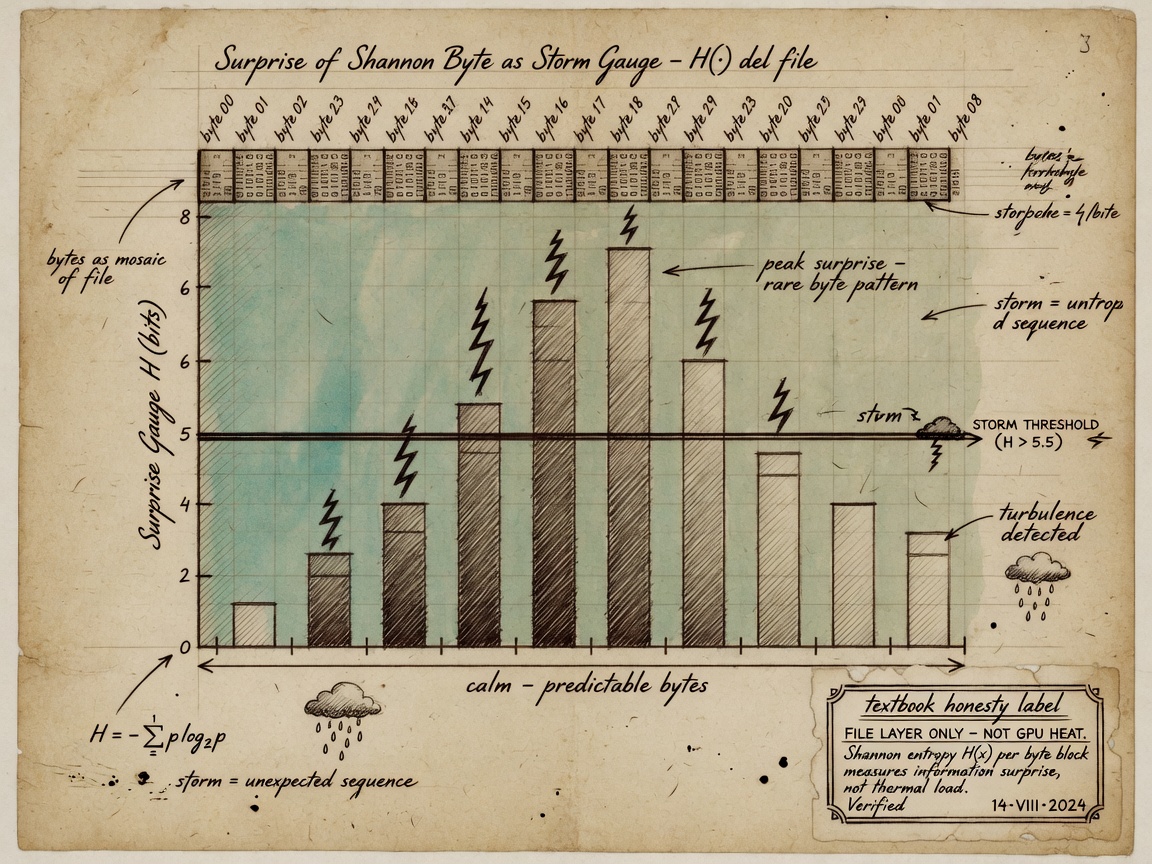
- Byte histogram to entropy
- Storm polling as daemon duty cycle
- High H on zip — corroborate, not auto-KILL
- Layer separation from GPU thermo
1. Introduction — storm gauge, not soul reader
Chapter 5 introduced the packet field as defensive perimeter. Chapter 4 separated ThermoAccountant frame entropy from file-layer signals. This chapter is the creditor deep dive for Claude Shannon — the oracle that measures surprise in byte distributions and tunes how hard NEXUS watches without auto-sentencing payloads.
Shannon is honored at ../creditors/shannon.html. His 1948 theory is not morality software. High H means slow down, corroborate, ask the operator. That is pastoral care encoded as engineering discipline — the 94/6 posture applied to bytes.
2. Shannon entropy — H = −Σ p_i log₂ p_i
For discrete symbols with probabilities p_i, Shannon entropy measures expected surprise in bits per symbol. Uniform random bytes approach 8 bits per byte. English text sits lower. Compressed or encrypted payloads push high.
The formula uses log base 2 because engineers count bits. The negative sign makes positive surprise a positive number — intuitive for thresholds.
In NEXUS, H is computed on file samples and payload windows. It is Implemented as Entropy Oracle behavior — grep-able, tunable, separate from GPU thermodynamics.
3. Storm thresholds — calm, alert, storm
Daemon polling tiers mirror weather discipline:
Calm: baseline cadence when H stays in expected bands for known file types. Alert: increased sampling when H rises above calm ceiling — packed executables, encrypted archives, obfuscated droppers. Storm: aggressive corroboration — more context, more operator attention, still not automatic kill.
Storm is a gauge needle, not a gavel. Field Technology refuses products that treat entropy spikes as verdict without human or multi-signal corroboration.
4. NEXUS layer — where the oracle lives
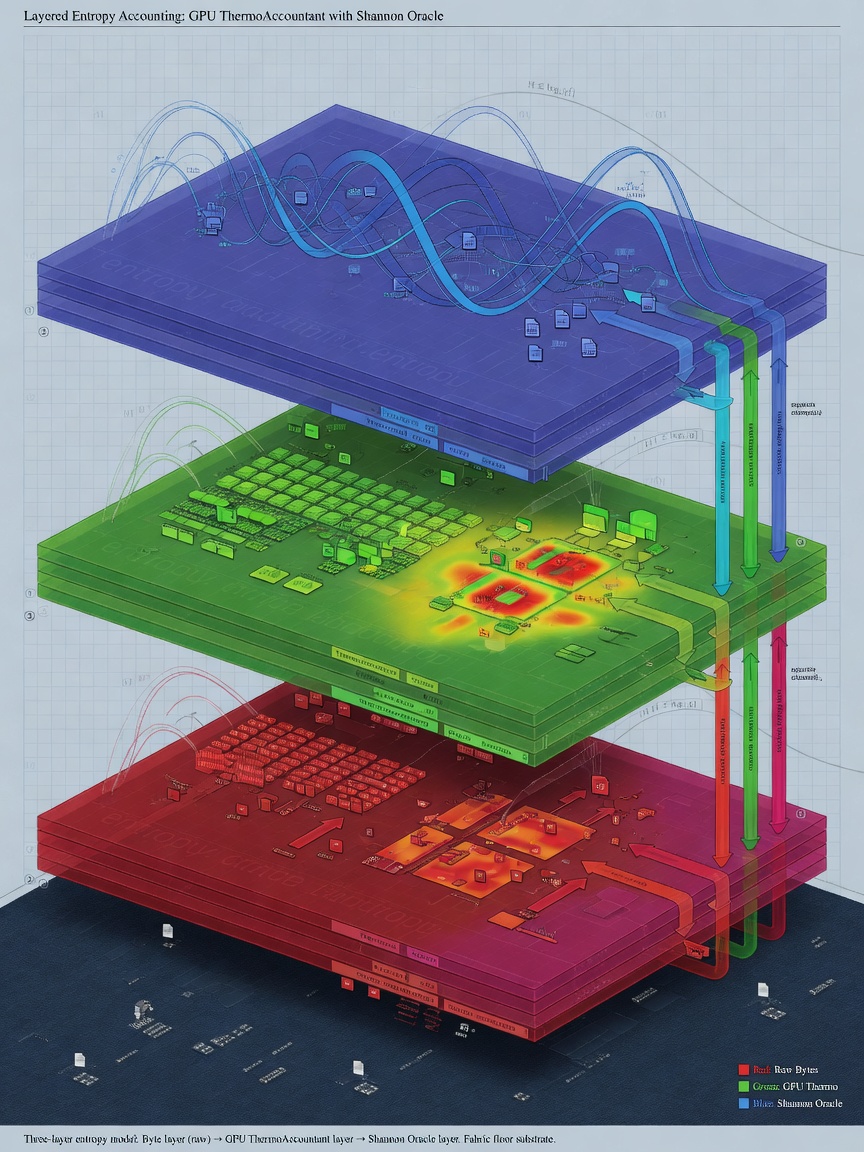
ThermoAccountant lives in AMOURANTHRTX dispatch_canvas(). Shannon oracle lives in NEXUS-Shield file analysis and related daemon loops. Different products, different bindings, different grep patterns.
Conflating them is how vendors sell one dashboard that lies about both thermodynamics and file surprise. Chapter 12's honesty table exists to stop that fusion.
5. High H — what it does and does not mean
High H may indicate encryption, compression, packing, or genuinely random payloads. It may also appear in benign encrypted backups you created. It does not prove malice. It proves surprise relative to model expectations.
Operators learn to pair H with process path, port habit, gatekeeper history, and sealed time context. Single-metric theology is vendor candy.
6. Low H — complacency risk
Low H is not automatic safety. Polyglot files, structured malware with repetitive shells, and staged droppers can present deceptive distributions early. Calm thresholds should not anesthetize.
Defense is field literacy across packet sentences, file oracle, and fabric observability — not one green LED.
7. 94/6 posture in bytes
Field Technology's 94/6 discipline: most traffic should pass calm observation; the long tail of surprise earns disproportionate attention without choking the perimeter. Shannon thresholds implement that tail detection.
This is operational mercy: do not DDoS your own machine with paranoia polling on every calm byte.
8. Separation from Landauer and fabric entropy
Landauer bounds erasure thermodynamically in theory. ThermoAccountant proxies frame irreversibility on GPU. Shannon measures symbol surprise in files. Entropy floor biases fabric noise. Four related words, four layers. Name them separately in reports.
9. Operator corroboration workflow
When oracle enters alert or storm:
Pause auto-actions. Pull process path and parent chain. Check packet field jsonl for recent socket habits. Compare sealed time receipts if sync enabled. Ask whether file is expected (backup job, dev build). Escalate with labels: Implemented signal, not Philosophy verdict.
Chapter 18 covenant: daemons assist; you inherit conscience.
10. False positives and tuning
Thresholds are tuned discipline, not cosmic constants. Operators document baseline H for their own build artifacts, backup tools, and game engines. Custom calm bands prevent alert fatigue.
Alert fatigue is an attack surface — when everything storms, nothing storms.
11. Relation to DPI and packet field
Deep packet inspection samples flows; file oracle samples artifacts. Spiderweb and packet field (Chapter 5) give network-position context; Shannon gives byte-surprise context. Correlation is strength; fusion into one lying score is weakness.
12. Shannon as creditor pedagogy
Read ../creditors/shannon.html tribute. Communication is care made serial, the love block says. Quantifying surprise is how care scales without pretending to read souls.
Teach newcomers Shannon before they touch storm knobs. Teach Chapter 12 before they quote H to management.
Operator drill 14.A — sample H on known files
# Calm baseline: plain text README
# Alert sample: gzip -9 packed binary
# Storm sample: encrypted archive you control
# Record H bands and daemon tier shifts in field jsonl
Operator drill 14.B — corroboration table
# For one alert event, fill: path, H, process, port habit, operator verdict
# No verdict without two independent signals
Operator drill 14.C — separation grep
grep -E 'THERMO|entropy' amouranth-run.log   # GPU layer
grep -E 'H=|oracle|storm' nexus-field.jsonl  # NEXUS layer
Study questions
- Write Shannon H in symbols and explain log base 2.
- Define calm, alert, storm as operational tiers.
- Why is high H not automatic malice?
- Where does Shannon oracle live vs ThermoAccountant?
- What is 94/6 posture applied to bytes?
- Name three corroboration signals besides H.
- How does alert fatigue become an attack surface?
- Why must vendors not fuse thermo and file dashboards?
- Read ../creditors/shannon.html — love block meaning?
- When should storm tier not trigger auto-kill?
- How do packet field and file oracle complement each other?
- Document a false positive you tuned away.
Tribute: Claude Shannon · All creditors
Chapter 15 — Maxwell on the GPU →
13. Byte distributions — worked intuition
ASCII text peaks on printable bytes. UTF-8 text shows multibyte structure but remains far from uniform. gzip and zlib lift high bytes. AES ciphertext approaches flat histograms. Operators build intuition by histogramming their own artifacts before touching production storm knobs.
14. Entropy Oracle implementation posture
NEXUS implements file-layer analysis as Implemented behavior — thresholds in config, jsonl rows on events, panel visibility at :9477. The oracle does not replace packet field gatekeeper; it corroborates. Implementation claims require grep in lib sources, not wiki quotes alone.
15. Storm tier tuning worksheet
Document calm ceiling for: plain source trees, release tarballs, your own encrypted backups, game asset packs. When a new build class appears, update calm bands before alert fatigue trains you to ignore storms. Worksheet belongs in operator runbooks beside firewall rules.
16. Adversarial surprise without malice
Packers raise H. Legitimate packers used by your own release pipeline also raise H. The oracle asks you to slow down, not to moralize bytes. Correlation with signature age, publisher habit, and sealed time context separates pipeline noise from novel noise.
17. jsonl as storm archive
Each alert should leave a row: timestamp, path, H estimate, tier, process context, operator note field empty until filled. Future you is a neighbor (Chapter 16). Couple with care through complete rows.
18. Shannon in threat models
Threat models that only list CVEs miss distribution surprises. Add H bands to tabletop exercises: what happens when calm misclassifies encrypted exfil shaped like your backups? Answer: corroboration, not auto-kill — covenant Clause IV and VI together.
Creditor deep-dive workshop — complete once
Chapters 13–15 share one drill set — complete after reading all three creditor chapters.
- Primary source: Footnote one Landauer, Shannon, or Maxwell paper (not Wikipedia alone).
- Grep proof: One
grepcommand tying this chapter's equation to an Implemented or label from Chapter 12. - Layer separation: Write three sentences — GPU proxy, file oracle, theory — never summed into one entropy number.
- Comparative run: Two matched sessions; plot
entropyThisFrameor file H trend — comparative only, no joule billing.
Operator journal — Shannon oracle and storm thresholds
Maintain a paper or markdown operator journal for Shannon oracle and storm thresholds. Each drill entry: date, hardware, driver, git hash, three THERMO or jsonl lines, one surprise, one label (Implemented / Metaphor / Philosophy). Journals become your personal creditor — future you inherits coupled state from past you. Bring the journal to Chapter 18 covenant audit drill 18.A as evidence.
Reading companion — Shannon oracle and storm thresholds
This reading companion reinforces Shannon oracle and storm thresholds for self-study tracks. Week one: read the chapter straight through with Chapter 12 open. Week two: complete all operator drills on hardware you own. Week three: write a one-page creditor tribute response linking ../creditors/ reading to a grep result from your machine. Week four: teach another human one section using the three-tag labeling exercise. Field Technology v5 measures success in reproduced receipts, not in vibes.
Cross-links: Chapter 4 entropy receipts, Chapter 5 packet field, Chapter 8 data bus, Chapter 10 Spiderweb mirror, Chapter 11 observability, Chapters 16–18 sacred covenant. Shannon oracle and storm thresholds is not an island — it is a creditor lens on the same stack you already run.
Honesty reminder: AMOURANTHRTX, NEXUS-Shield, Queen, and Field Primer have different licenses. Teaching from this chapter does not automatically license commercial engine use. Point students to product headers and FIELD-TECHNOLOGY-V5.md for edition boundaries.
Chapter closing — Shannon oracle and storm thresholds
Chapter 14 completes the oracle story: H is a storm gauge, tiers are pastoral engineering, corroboration is covenant habit. You are not learning to fear bytes. You are learning to slow down when surprise spikes — the same discipline you bring to THERMO spikes without confusing layers. Shannon's creditor page reminds us communication is care made serial. Serialize care into jsonl rows with timestamps and operator notes, not into auto-kill theater.
Evidence anchor — grep and sources
Major claims in this chapter anchored for reproducibility. Implemented = grep today; = intuition; Philosophy = discipline.
| Claim | Statement | Label | Evidence |
|---|---|---|---|
| Shannon H | File byte surprise | Implemented | NEXUS Entropy Oracle |
| Storm thresholds | Alert tiers on H | Implemented | Configurable gates |
| Fabric texel H | Shader spectrum | Category error if merged | |
| Gatekeeper merge | Verdict from H alone | Forbidden — separate plates |
H = −Σ pᵢ log₂ pᵢ on file byte distribution
grep -r 'entropy_oracle\|storm' NEXUS-Shield/
Source paths
NEXUS-Shield/entropy_oracle.pydocs/creditors/shannon.html
Chapter summary — before you turn the page
Shannon surprise on files — storm gauge tuned, never merged with GPU thermo or gatekeeper auto-sentence.